“Zionist”: the euphemism

1

The verb “caress” in this page from H. L. Mencken’s essay “On Being an American” prepares us to accept a rhetoric of self-conscious self-repudiation. “Caress” isn’t really going to give us a hug, of course. “Did you think I was?” it asks us, and it comforts us by assuring us that of course it means no.

Meaning what it says, that No imposes irony on the word “American.” It tells readers that H. L. Mencken knows something about Americans (other than Mencken and us his readers) that Americans (other than Mencken and we his readers) don’t know. As if intending to be overheard from a great distance at the top of its lungs, it confides itself to its readers as de haut en bas as it can.
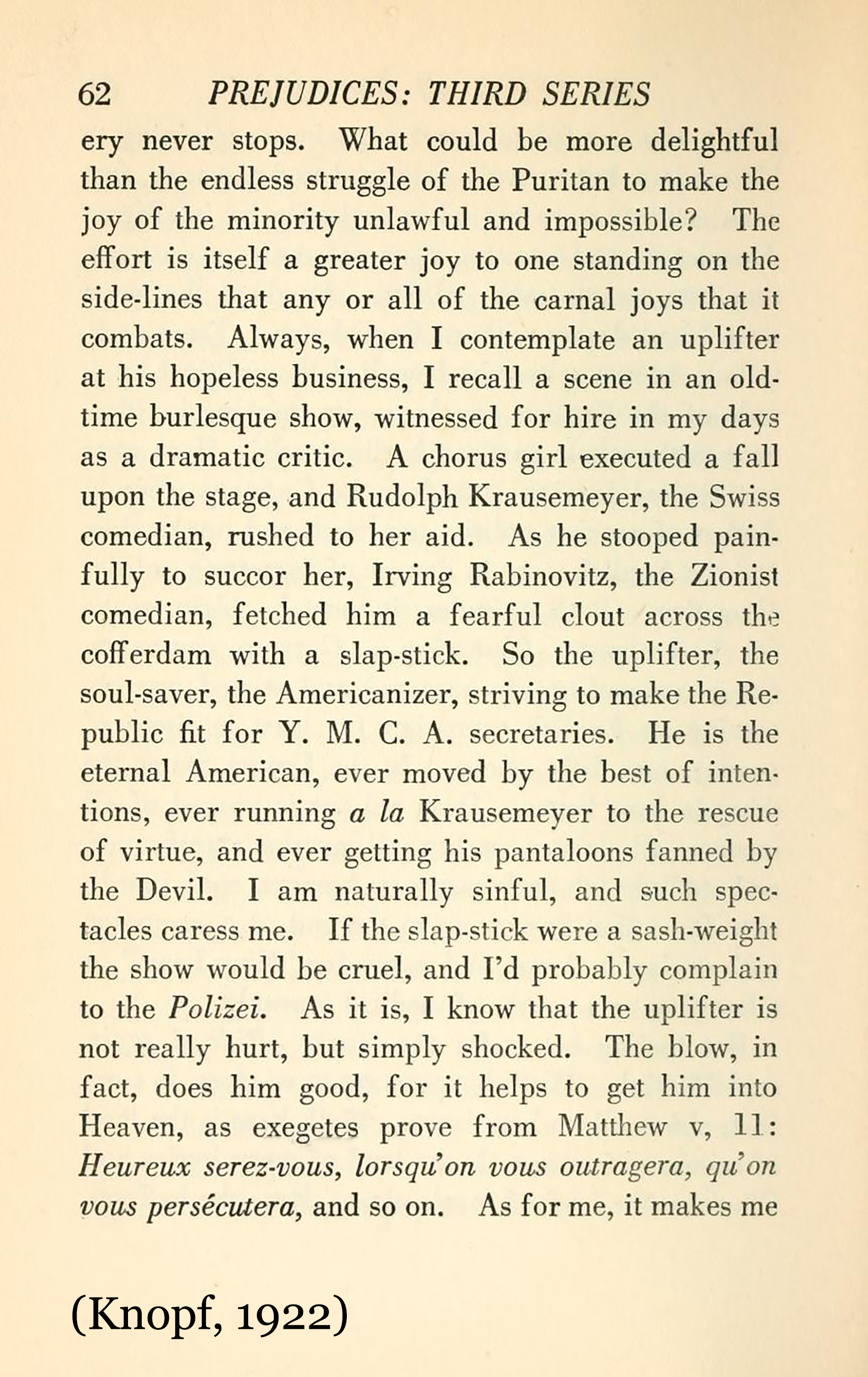
So when Mencken speaks of himself “witnessing for hire in my days as a dramatic critic,” he is setting up a joke that we will get. For us at the door of his dressing room who did the homework in advance, Mencken’s vocabulary works within genre formalities that condition us to deliver our applause.  Fully made up, the terms witnessing and dramatic critic and the Henry James cadence of the pauses before and after for hire costume themselves in the role a word at a time with a dignity which suddenly unzips, exposes itself, and turns into an old-time burlesque show. It’s the skillful speed of the change that makes us snicker when the act haw-haws to its punchline euphemism cofferdam. 

Some readers won’t snicker, of course. Too busy on campus to go to class, they won’t have learned the vocabulary of laughter. We will, though, because we’ve been reading Mencken and Mencken has been teaching us. Irving Rabinovitz, the Zionist comedian — the Americans that Mencken has been telling us about will be oblivious to the dirty word he didn’t say out loud, but we won’t. On an earlier page of the essay (21) he has already pulled on his rubber gloves and explained, “The queen of the haut monde, in almost every American city, is a woman who regards Lord Reading as an aristocrat and her superior, and whose grandfather slept in his underclothes.” At the time of Mencken’s writing, Lord Reading was Rufus Isaacs (1860-1935), Marquess of Reading. He had served England as Lord Chief Justice, Foreign Secretary, and Viceroy of India, so perhaps he actually was superior to some queen or other of the American haut monde. But we readers of H. L. Mencken know better. We know — nous autres! — that under his coronet and inside his robes of office, Rufus Isaacs was nothing but a Jew.

2

Or, as they bellow on campus in 2024 but H. L. Mencken wrote in good prose in 1922, a Zionist.

Book review, two portraits, and short story beginning, “Als Gregor Samsa eines Morgens aus unruhigen Träumen erwachte, fand er sich in seinem Bett zu einem ungeheueren Ungeziefer verwandelt.”

Jackson_Daily_News_Wed__Mar_7__1906A topJackson_Daily_News_Wed__Mar_7__1906A bottom

Jackson [Mississippi] Evening News, March 7, 1906, page 2

Nicola Perscheid, “Prof. Dr. phil. Theodor Lessing — Schriftsteller,” about 1925. Staatliche Landesbildstelle Hamburg, http://sammlungonline.mkg-hamburg.de/de/object/Prof.-Dr.-phil.-Theodor-Lessing—Schriftsteller-/P1976.857.936/mkg-e00137302. Photoshopped to restore contrast.

Theodor Lessing’s contribution to language is the title of his 1930 book about Otto Weininger: Jüdischer Selbsthaß, “Jewish self-hate.”

Language note: the possessiveness of the pronoun “our”

The Department of Asian Studies at my university is now circulating a petition which reads, in part:

In response to and strong condemnation of recent expressions of hate directed at Muslim and Jewish communities in Hawaii, we endorse the following statement:

Over the past weeks the Manoa Mosque has been the target of multiple hate messages via social media, email, and voicemail. Individual Muslims have been harassed in public, including children. Also, Temple Emanu-El was targeted with a bomb threat against its Jewish pre-school.

We stand together with our Muslim and Jewish communities and any individuals who are subjected to harassment based on religion, immigration status, national origin, race, gender, LGBTQ+ status or disability. No one should go through this experience alone.

That’s how compassion expresses itself in current academic language: categorically, sorting its intended beneficiaries by administrative identifiers: “religion, immigration status, national origin. . . .” And along with the compassionate categories, as a logically required complement, there are also anti-compassionate categories: for instance, “the US” in a recent contribution from my department titled “The Homes of Zionism: Circuits of White Supremacy between the US and Israel.” There, the Marxist term “the US” functions in the same way as the Republican term “Democrat Party”: as an ugly, unidiomatic locution meant to make its subject sound ugly and alien. But that’s the way my department talks, and the attitude toward Jews represented by conflating Israel with the Klan is what a consensus lexicon sounds like.

Considered that way, as the lingua franca of everybody who matters, it has an important thing in common with the compassion-categories of the petition: it is the vocabulary of a collective mind named “we.” If we were to try thanking that “we” for its compassion for the Jewish community, we might acknowledge the significance of the generous impulse by pointing out that Israel too is a Jewish community — in fact, a Jewish community created expressly to protect against the social consequences of hate. But of course, that time, our gratitude wouldn’t be wanted. It would not only be rejected; it would be misunderstood, uncomprehended, estranged from meaning.

Grammar would have accomplished the alienation. In the instant of its being heard, the possessive pronoun “our” in the petitioners’ phrase “our Jewish community” controls and limits admission to the meaningfulness of the term “Jewish community.” By modifying “Jewish community” to “our Jewish community,” it changes the reference of both “community” and “our” from terms that include to terms that exclude. Modified in that possessive way, the term “our Jewish community” instructs its speakers to think of Jews as theirs to possess — pets, say, who belong where the human community says they belong and nowhere else.


*

A footnote to the note: William Safire’s The New Language of Politics: A Dictionary of Catchwords, Slogans, and Political Usage (rev. ed., 1972) traces the history of the term “Democrat Party” back to Thomas E. Dewey in the 1940s. During the same era, cartoons in Socialist Camp periodicals like Ogonyok routinely identified villains as American by depicting them wearing the U. S. Army’s “U.S.” lapel badge. The artistic fascination with that un-Cyrillic squiggle lives on in North Korea, even when the artists get it backward: