
Emily Dickinson
As war approaches, a poet reads a page
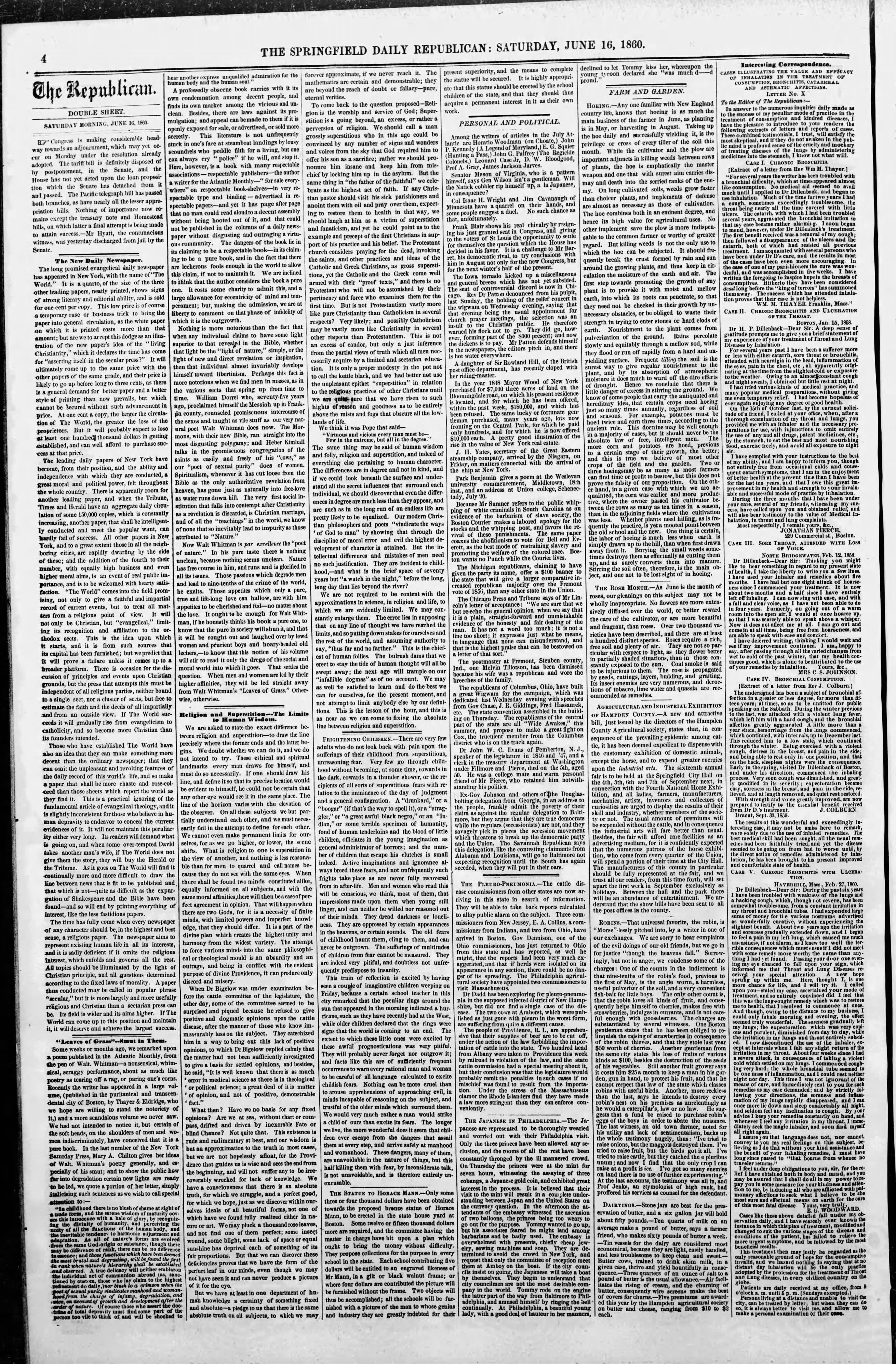
The author of the editorial about Whitman was the Dickinson family’s fatuous friend J. G. Holland, then the assistant editor of the Republican and later the best-selling author of Miss Gilbert’s Career: An American Story, a didactic novel whose thesis is that a woman can’t be happy until she has a man with a thumb powerful enough to hold her under.
I am out with lanterns, looking for myself
After Darwin, the fossil record
This lurid face once emitted glares and thunderous sounds. Between 1808 and 1900 it was the body of the theologian Edwards Amasa Park, and it influenced American literature at least once: certainly when Emily Dickinson recorded her awed reaction to one of his sermons in a letter to her brother (JL142, November 21, 1853), and later, perhaps, in the form of a poem:

But its physical record is a history of extinction. See how much of the silver-mercury amalgam has been damaged and how little remains. To construct even this partial objet d’art cost me a debt of indeterminable amount to the artifact-generating computer technique called artificial intelligence. With black and white artificially replacing daguerreotype silver, see:

No, it isn’t visible to you now; not accurately, not in any way that would have been received with assent by anyone sitting in a hardwood New England pew in 1853. The Origin of Species was published in 1859, and in due time Emily Dickinson wrote ruefully about it. You see your images now in an evolved way, through a color filter.
So fall into line. You have no choice but to be received into the epoch of tangerine.

It’s in your constitution now.
For detail about Dickinson and Park, see Alfred Habegger, My Wars Are Laid Away in Books: The Life of Emily Dickinson (Random House, 2001), pp. 310-313.
The 1847 daguerreotype of Emily Dickinson, now times 2
In 2021, I published a little Issuu history of a daguerreotype of 16-year-old Emily Dickinson. As of 2023, that image remains the sole fully authenticated photograph of the poet, and my book included an attempt at using artificial intelligence to restore its contrast and detail. The original and the restoration can be found in the book at
But in 2023 I upgraded my computer and its software, and rerunning the restoration now brings back so much more history that separate pages can be seen once again in the book on the photographer’s table. If I still had the Microsoft Word text of my own 2021 book, I’d replace the old image there with the new one and hit Republish. The Word text is long deleted, though, and to change that one page now I’d have to retype the whole book and then hassle with Issuu.
But see the new restoration by itself: a 2023 electronic state of the poet Emily Dickinson in 1847. At the least, more of the fabric in her dress is visible to you now than it was to me in 2021.

But see too: as she explained in advance to Thomas Wentworth Higginson (1862; JL268), the only true way to see Emily Dickinson is wordwise: not as an illustration but with the mind’s eye.
Dickinson: in mitigation
What Randall Jarrell said about Robert Frost is also true of Emily Dickinson: her best poems are almost as beloved as her worst. But here’s some scholarship in mitigation.
First the poem: Fr982, as it usually is formatted online.
If I can stop one heart from breaking,
I shall not live in vain;
If I can ease one life the aching,
Or cool one pain,
Or help one fainting robin
Unto his nest again,
I shall not live in vain.
Second, historical evidence for the genteel pronunciation of “again.” In the sequence beginning at about minute 18:30 of
https://www.youtube.com/watch?v=IQV0AeRwmj4you’ll hear it: “eggayne.”
Third and decisively, artificial intelligence has motored up at last with aid for the fainting robin. Perhaps the stretcher bearer was Ernest Hemingway.

Where it came from


Observation at coarse focus: metaphor’s long operating distance
The metaphor: by Emily Dickinson, Fr741.

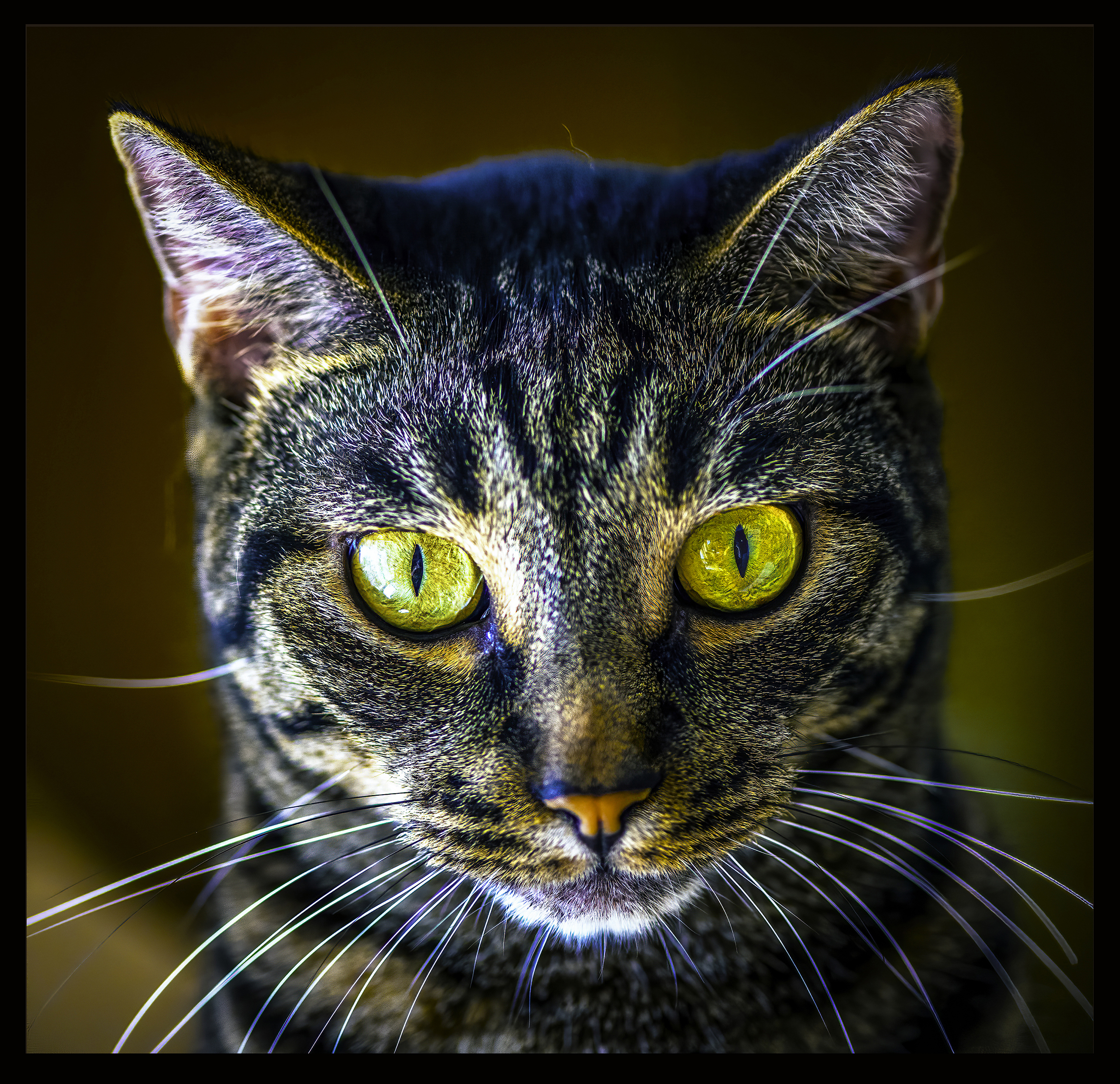
Its point of view is behind thick, scream-deadening glass, and the glass is nineteenth-century windowpane, wavy and bubbly. If it were optical glass, you would see, instead,

or, with a click of a rotating turret

Then full stop. Observe the yellow eye afterward, too, if you choose, but your only humbly honest recourse is probably not to dare to think about it.
Sunkist: the myth of Clytie


Punctuate

