Karajan’s brass and timpani prepare to sound Also sprach Zarathustra, and in volume 1 of his magnificently tinted Locupletissimi rerum naturalium thesauri accurata descriptio, et iconibus artificiosissimis expressio, per universam physices historiam, Albertus Seba has published an image of an object actually present to the senses in a Wunderkammer. Until now it had been only an idea articulated as a myth, but now it is an artifact. You can see it, touch it, smell its museum smell. In its museum it has a proper name: the hydra of Hamburg.
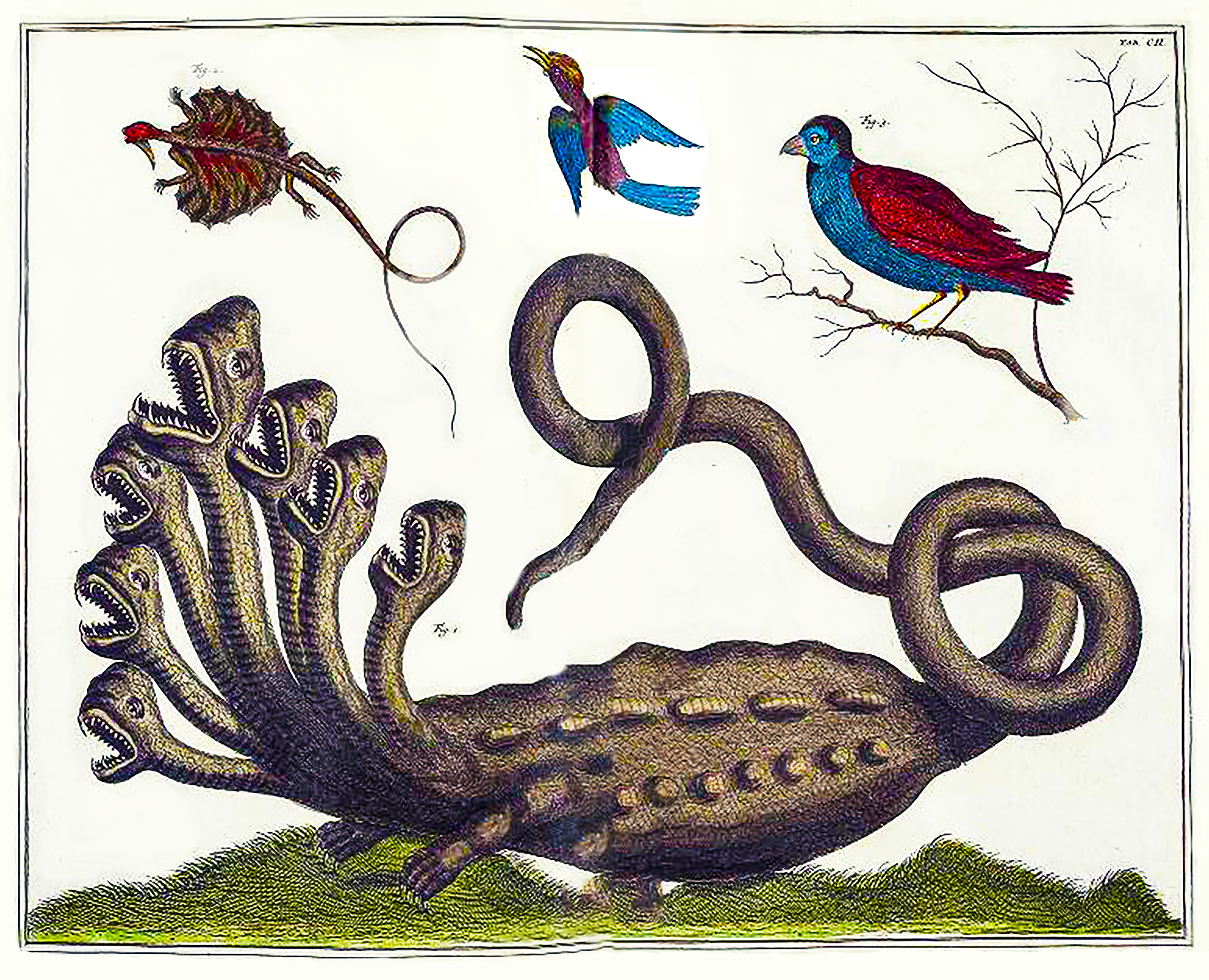
One year later, however, Carolus Linnaeus will dissect the corpus and conclude that it is a fabrication cobbled together, as literally as can be, from the skins and teeth of various snakes and ferrets and weasels. After Linnaeus added that he thought the stitchery could have been the sewing-circle work of monks fabricating proof-texts for the Book of Revelation, he had to run from Hamburg for his life – again, as literally as running could be.
https://royalsociety.org/blog/2022/01/redacting-the-hamburg-hydra/
—
In the first age of Karajan, it was the fashion to approach the movie screen, lie down on the floor in front of it, and croak, “Oh wow, look at the colors.”
Later generations of the age of Karajan are still looking. Their skulls show the scars of fresh new stitches, and the colors are agleam as always. The hydra never has stopped moving its feet or gnashing its teeth.