Early in the twentieth century, some American newspapers’ coverage of the arts was distributed by syndication from large metropolitan dailies to smaller papers in smaller towns. Between 1926 (the year of Hart Crane’s White Buildings) and 1930 (the year of The Bridge), for instance, readers of The Portage Daily Register of Portage, Wisconsin, or The Valley Morning Star of Harlingen, Texas, could have learned in some critical detail who Crane was and what language he was writing. Hart Crane’s geography for that period in Newspapers.com was impressively extensive.
But it did almost skip the Territory of Hawaii. Between 1926 and 1930, Hawaii’s newspapers seem to have had only three things to say about Crane, and two of those were trivial: a title in an advertisement for forthcoming books and a name-drop in a feature piece about tourist traps in Paris. But into the midst of that emptiness came this third thing.
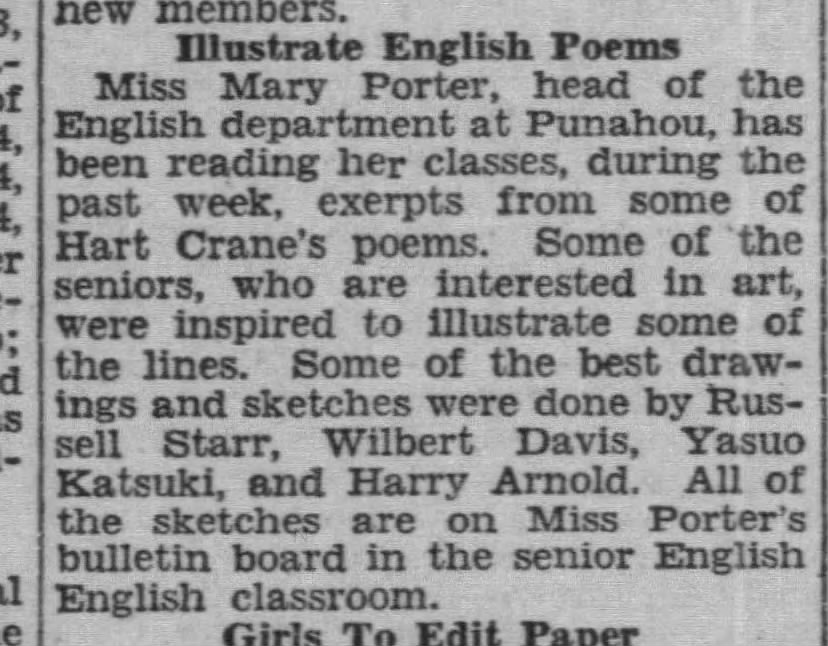
In the Honolulu Star-Bulletin for Saturday, February 18, 1928, this paragraph from a page headed “News of School Activities in Hawaii” looks something like a retrospective glimpse of an avant-garde, advancing. From a different biographical vantage, too, it seems on the verge of a double audibility in the way Miss Porter says “a long time.” Through her an institutional voice can be heard reminding Miss Porter and us that “a long time” can mean not just the length of a language teacher’s career but an epoch in the history of her language.
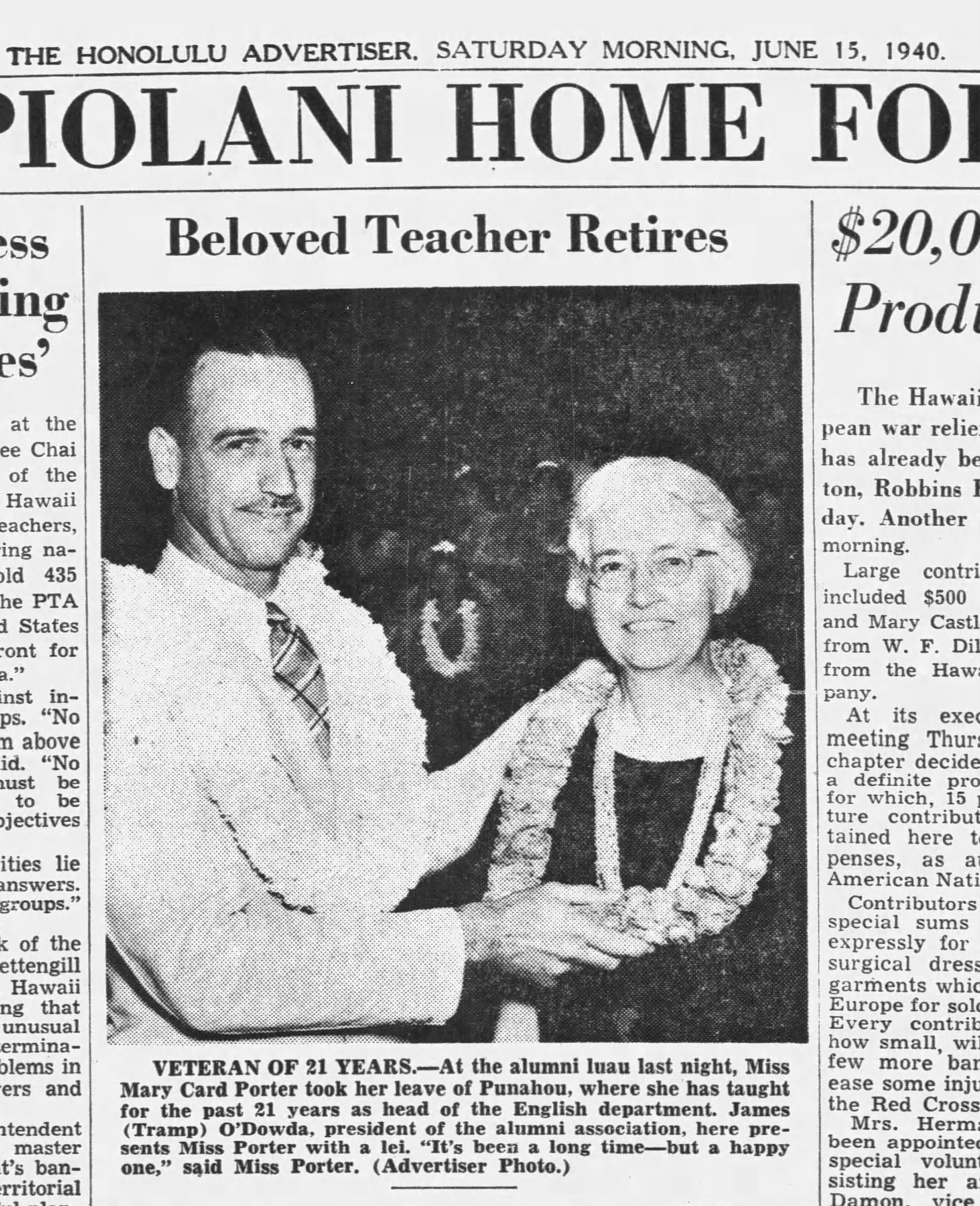
Established in 1841 by New England missionaries who allied themselves with Hawaii’s native monarchs, Honolulu’s Punahou School has continued on the course of conquest and enterprise marked for it by its founders. One of its alumni was Hiram Bingham III, a grandson of the missionaries’ leader and, in his own right, the explorer of Machu Picchu. An alumnus with a different sort of biography is President Barack Obama, who grew up in a small off-campus apartment and worked in the neighborhood Baskin Robbins. What we seem to be reading about pioneers like those seems to be a story about a beginning which hasn’t ended. It keeps bringing the idea of ending into itself and making it a member of its family: time’s family, the history of continuum.
A moment earlier in the continuum, the family had sounded like this.
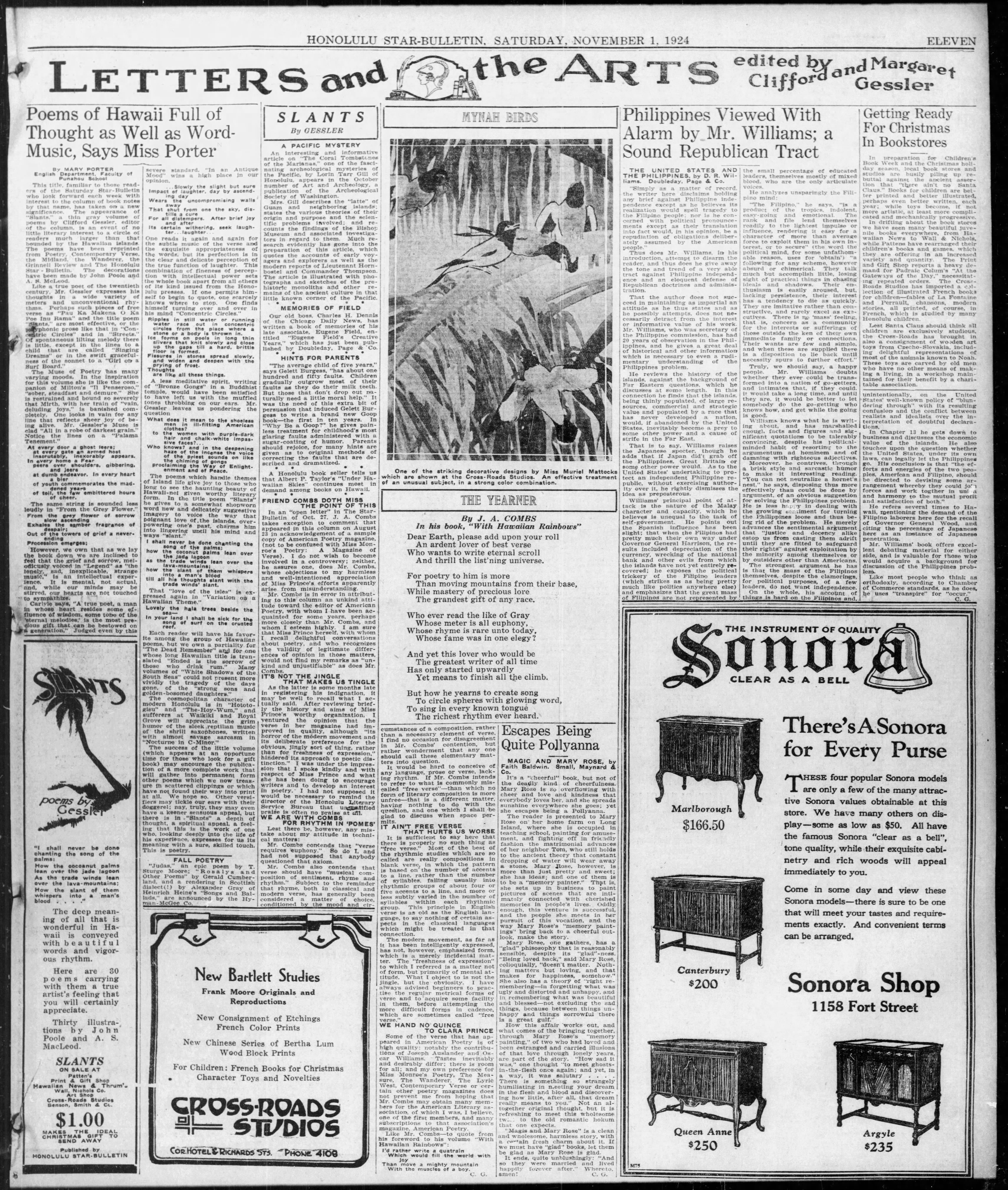
That is, it still included some great-aunts and -uncles who said Miss-Porter-in-1924 things like “Nay, truly.” The radios in those elders’ homes, too, came named and cosmetically styled after a past before radio: Canterbury, Queen Anne. But the sounds radiating from their cabinetry seem to sing that the baby sketches delivered by Crane were successfully nested in Miss Porter’s crèche after all. They’re singing on their own now, and while vocabulary and the physics of echo remain, they may keep singing forever.
Love Crane’s shorter tributes to Melville and Dickinson in my very limited reading. The Broken Tower is a magnificent final masterpiece–too bad he jumped off the ship after writing it. Wish some others would jump off the Ship of Fools or any Bridge (or go back to Mars or South Africa) in these dark times.