Dating from 1960, Vasily Grossman’s very long novel Life and Fate tried to be a War and Peace for the twentieth century. If only in terms of ambition, it failed. It has mass but not copia. Its characters aren’t much more than Socialist-Realist animatronics allegorically posed.
But think of it as journalism. In 1944, when he wrote his newspaper article “The Hell of Treblinka,” the first publication in any language about the Nazi death camps, Grossman enlisted his imagination in journalism’s cause: the discovery of an event, some complex of memory and language which from just before page 1 was already in place on its own ground, on what Grossman then tried to make out as its own terms. For as long as such a complex is interpretable in the language a journalist and his readers have in common, it will remain current. Its lexicon won’t yet have stopped growing and then written on its last page, “But oh well, The End.” It will remain in the state of Unend. It will be Unend.
So during these 2½ pages from Life and Fate, Adolf Eichmann’s car transports us readers into Adolf Hitler’s brain and then the subject of the exposition shifts back to a teaching aid made of sturdy cardboard. No, of course: at least in Robert Chandler’s 1985 translation, Grossman is no Tolstoy. But read on, O viator, in the limousine’s wake. You are bound to the unend. 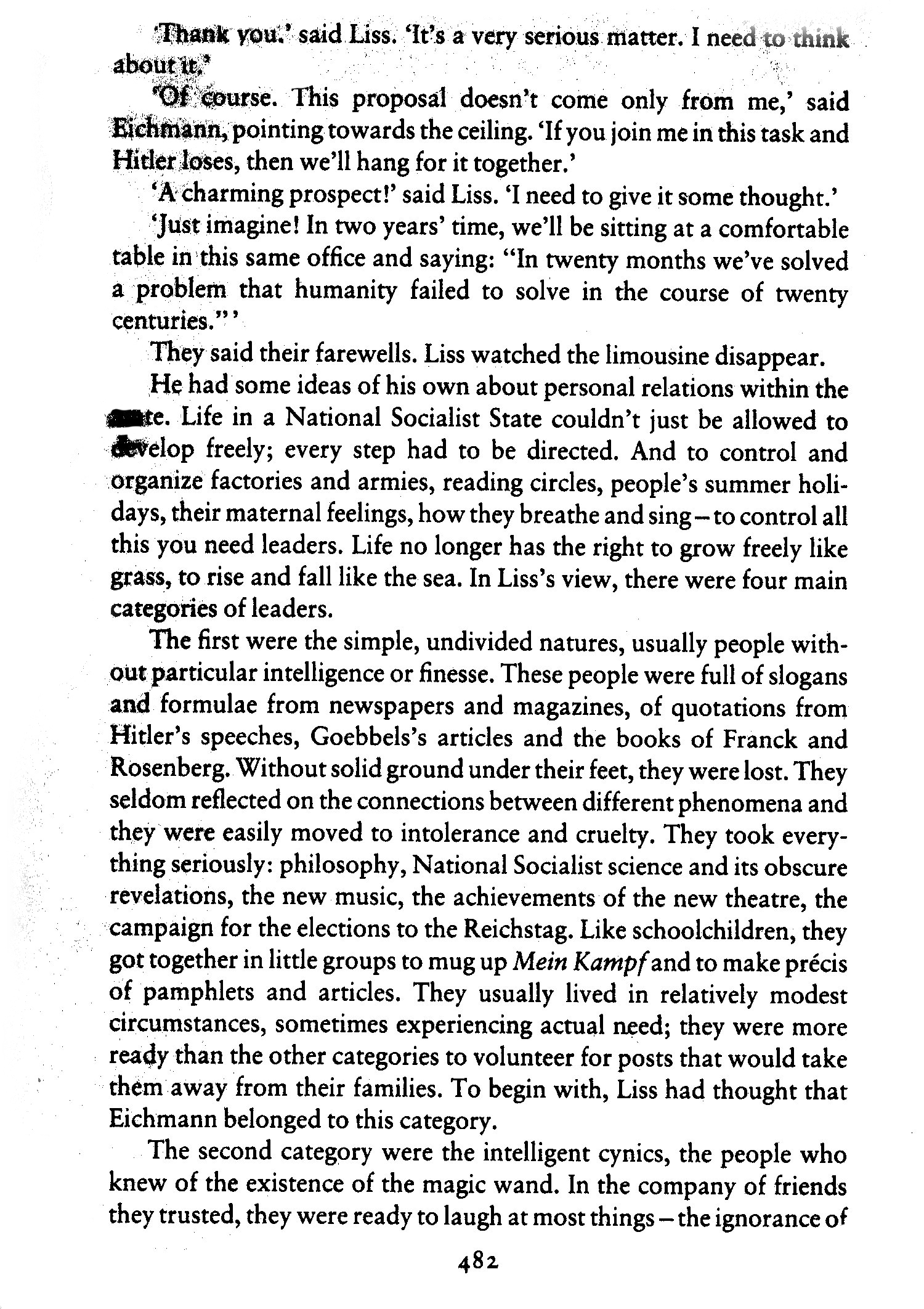
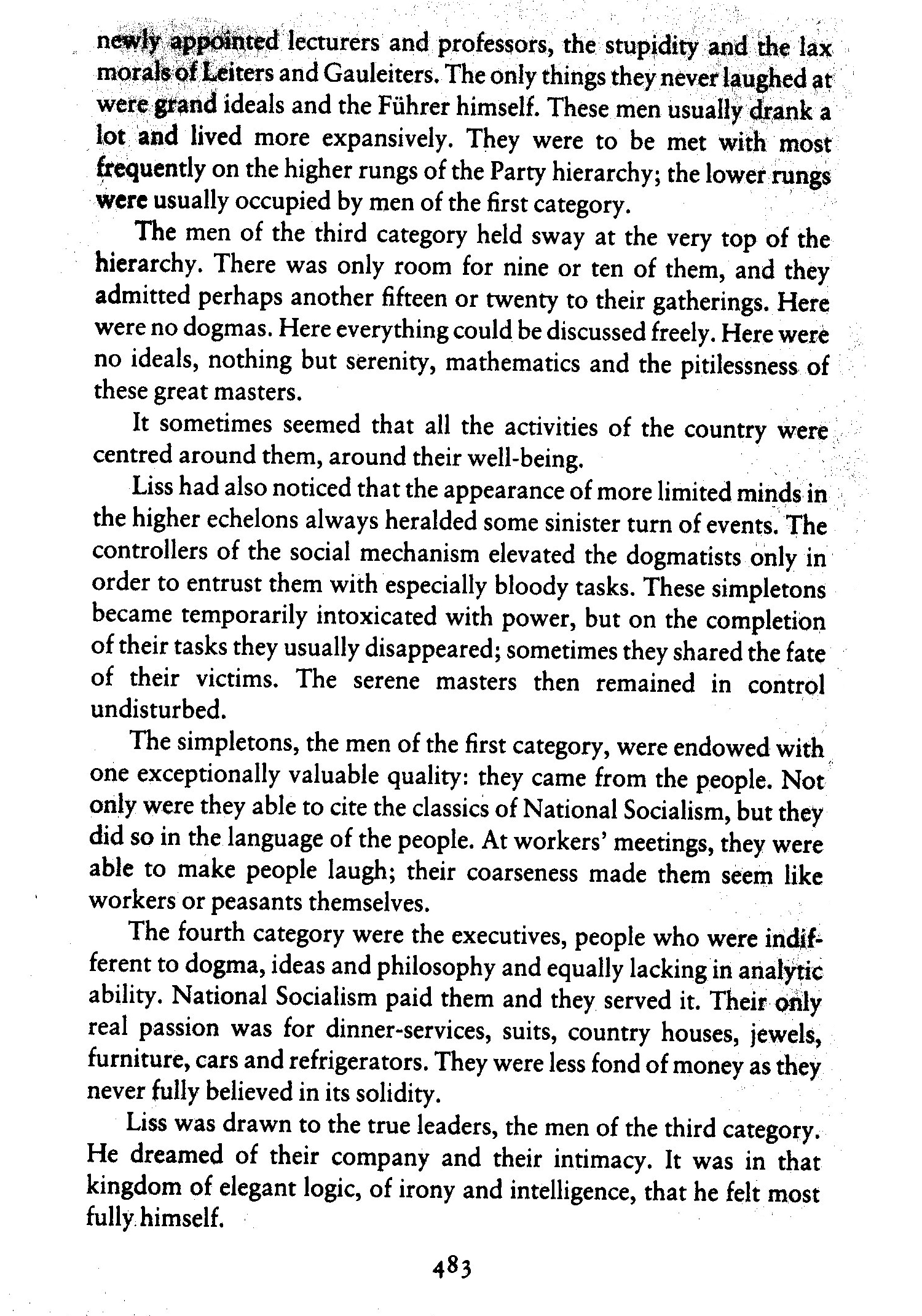
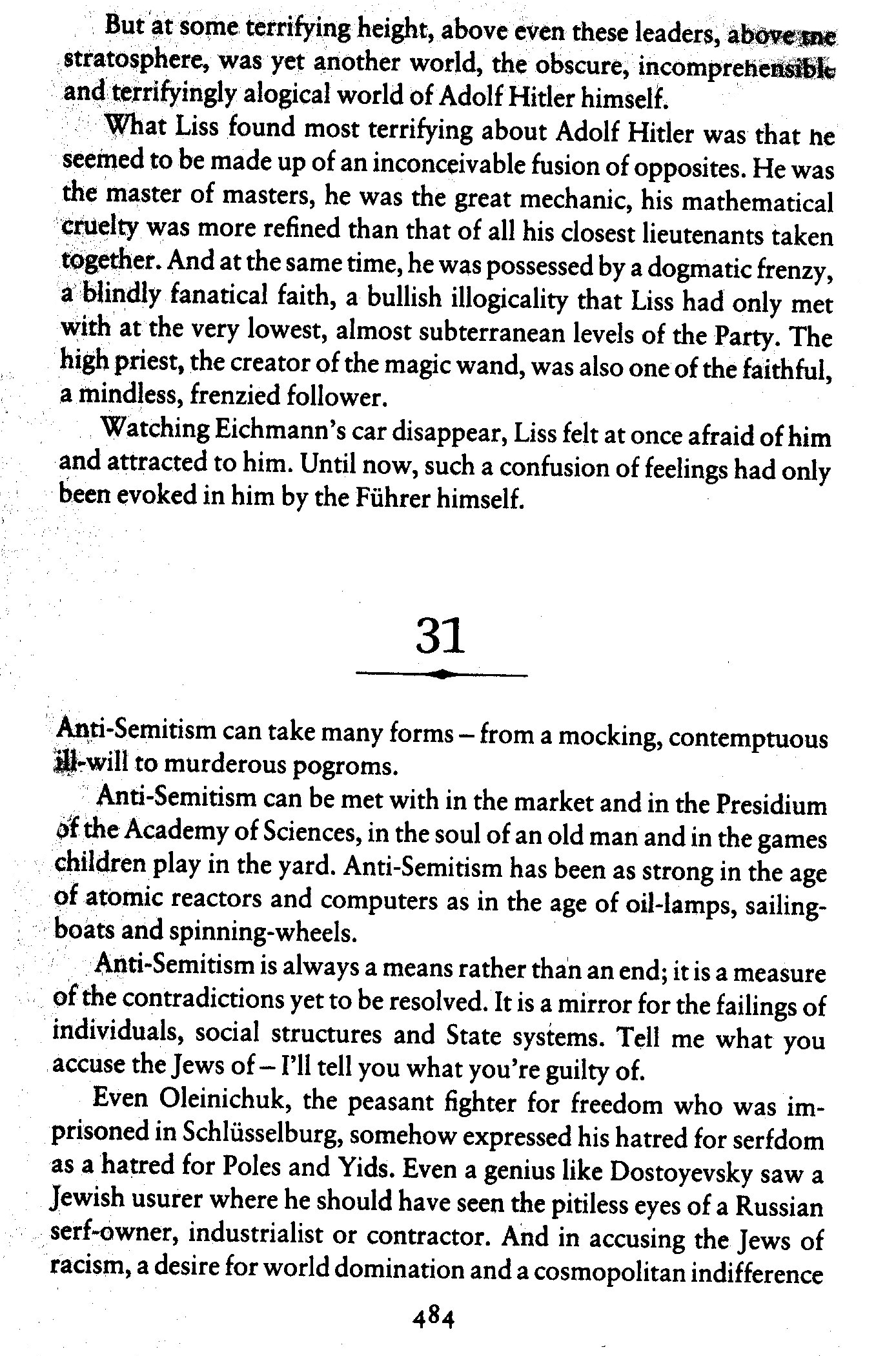
Afoot down the Autobahn through the blank, panting as you run alongside Grossman’s word “alogical,” consider adopting and naming an analysis of its biographical history. You might call it, for instance, “Carlylean hero” from before Hitler’s time or “Fox News” from the time displaying now at the foot of your monitor. But that won’t work any better, will it? It can’t, because what can’t be thought of (Grossman: “mindless”) must be a non-state: a state unbounded and unboundable; the unending, the audio “But wait, there’s more [of] but wait there’s more.”
Think of the endless night parade at the end of Triumph of the Will; think of the aspirational National Socialist term “working toward the Führer.” You want the real program to resume and the “The End” and the houselights to follow, don’t you? But they don’t seem to be on the way yet, do they? Eichmann’s ashes were scattered into the deep sea, but here you are still reading Grossman. Thanks to the literary genre of the current event, you and Eichmann are now adrift together, to the unend.
