On September 28, 1864, Emily Dickinson, a reader of the word home and of her family’s newspaper, the Springfield Republican, may have noticed this obituary of a lieutenant.

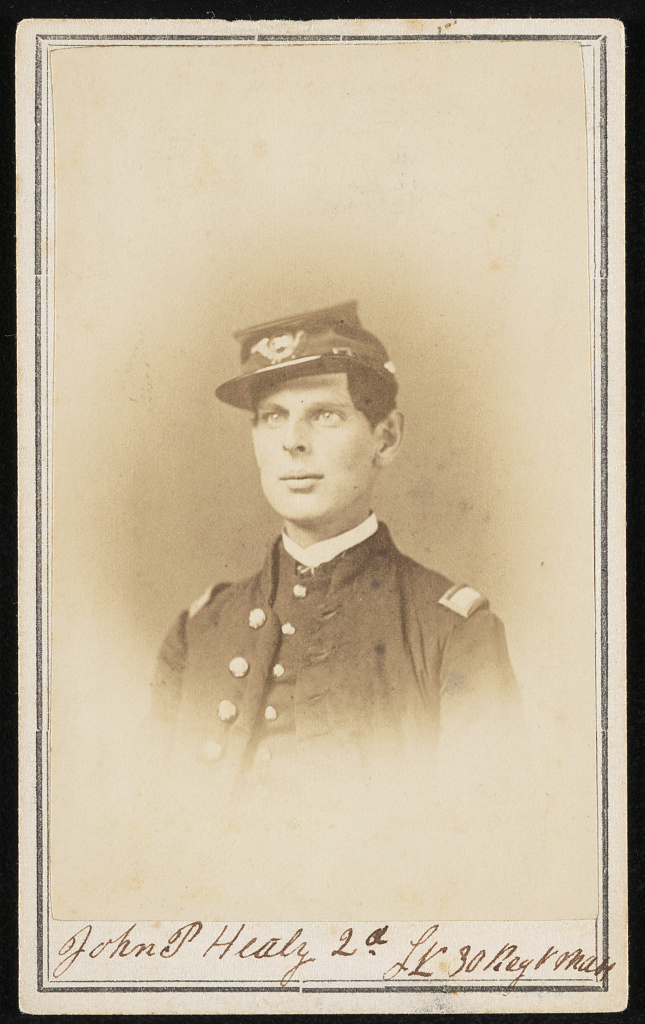
Among what else there remains of the second lieutenant now is a penciled prose note in what looks like twentieth-century handwriting. It’s set down on the reverse of a nineteenth-century photograph.

But the Library of Congress appears to have misinterpreted the historiographer’s abbreviation must. Lt. I don’t think it’s to be transcribed “First Lieutenant”; I think it may stand rather for “mustered as Lieutenant.” Detail in an earlier article that mentions Lieutenant Haley, “The Massachusetts Thirtieth in Boston” (Boston Evening Transcript, March 19, 1864, page 2) also explains why his photograph was taken in New Orleans, but that hasn’t made it into the Library’s Prints and Photographs Collection.
In Cambridge Cemetery, too, New England’s weather history seems to have eradicated every single word from the lieutenant’s tomb,

and of the albumen print made in New Orleans by E. Jacobs, only a browned trace remains, and, appended to a name in the overlooked caption, the designator “2ᵈ Lt.”
But the raindrops can now be made to appear to reascend. See them rise in the direction of their sky.

A change to the visual field has been effected, and with it a change in what you may think of now as a memory. See John Haley’s eyes. They look upward, as you may feel yourself to be looking. Above the rain there now appears to be a light source. At least something on a silver halide surface now appears to be projecting a man-shaped image.
—
The name of the projective something is artificial intelligence. It didn’t exist during the Civil War, and perhaps it doesn’t exist now. All we can say with certainty is that it appears to be a presentation to the eye of images never actually experienced. Those images were latent at best until now and perhaps not even in existence, but now that they’ve been seen they’re remembered (is that the word?) as if they they were parts of a past. They are depictions from life in a life that didn’t become a readable, knowable chronicle seeable until first a photograph and then, separately, a computer gave it the shape of a life.
Posed in about 1864 for a long exposure before a dry-plate camera in a room occupied by E. Jacobs and perhaps a watch with a second hand, the second lieutenant’s eyes a century and a half later are only depictions of instruments of seeing. Whatever they were then, they can be only remainder imaginings now. At clockable intervals between then and now, the lieutenant’s life story corrected itself by eradicating itself mark by mark from whatever remained of its not yet imaged text.
—
Correction, September 12, 2024: between April and November 1864 Dickinson was living not in Amherst but in Cambridgeport, so it is unlikely that she could have read the September 28 Republican. Thanks for reminding me, Ben Friedlander!